Choosing a WordPress 2FA plugin sounds simple until you start thinking about the person who loses their phone on a Monday morning.
The obvious job is to stop attackers from logging in with a stolen password. The less obvious job is to avoid locking out the owner, the store manager, the editor, and the developer who only logs in once a month. A good 2FA plugin has to do both.
For most WordPress sites, choose WP 2FA. It has the best mix of guided setup, free all-user 2FA, role policies, grace periods, backup codes, multisite support, and current maintenance.
Choose miniOrange 2FA if you need a larger MFA toolbox and are willing to manage more settings. Choose Wordfence Login Security if you want free 2FA with login hardening controls like CAPTCHA and XML-RPC protection. Choose MalCare if your real problem is broader than WordPress login security and you need malware scanning, cleanup, firewalling, vulnerability monitoring, and login protection in one security workflow.
That last distinction matters. A 2FA plugin guards the login door. It does not clean malware already inside the house.
The Best WordPress 2FA Plugins At A Glance
| Pick | Best for | Why it stands out | Watch out for |
|---|---|---|---|
| WP 2FA | Most WordPress sites | Free all-user 2FA, guided setup, policies, backup codes | Some advanced and WooCommerce conveniences are paid |
| miniOrange 2FA | Complex MFA needs | Many authentication methods, role controls, reports, integrations | Free plan is limited to three users and setup is heavier |
| Wordfence Login Security | Free focused login hardening | 2FA plus CAPTCHA and XML-RPC controls | Fewer 2FA method choices than miniOrange |
| Two Factor | Simple open-source 2FA | Free, maintained, profile-level setup | Less centralized policy control |
| Two Factor Authentication | Lightweight TOTP/HOTP | Simple authenticator setup from the UpdraftPlus team | Enforcement and emergency codes are premium |
| MalCare | Full-site security plus login protection | Adds scanning, cleanup, firewall, monitoring, and vulnerability detection | Not a standalone 2FA-only plugin |
If you only need one answer, start with WP 2FA. If you are managing a high-risk site, a WooCommerce store, or a client portfolio, read the tradeoffs before enforcing anything.
The plugin with the longest feature list is not always the safest choice. In a 2FA rollout, boring things like grace periods, backup codes, test users, and admin recovery are wha
How We Chose These Plugins
We evaluated these plugins for the work a real WordPress admin has to do, not just for the number of authentication methods on the product page.
The main criteria were:
- Setup clarity and time to a safe rollout
- Authenticator app support, especially TOTP
- Backup codes and lockout recovery
- Role-based or user-based enforcement
- Grace periods before mandatory setup
- WooCommerce, multisite, and custom login compatibility
- Free versus paid limits
- Maintenance signals from WordPress.org metadata
- Scope discipline: focused 2FA plugin versus broader security suite
- Long-term admin burden
We also reviewed the uploaded plugin code for WP 2FA and miniOrange 2FA. For WP 2FA, the code showed setup wizard surfaces, TOTP and email paths, backup code handling, policy settings, grace period defaults, shortcodes, WooCommerce login detection, multisite admin menus, and passkey-related classes. For miniOrange, the code surface was much larger: setup wizard, role policies, TOTP, email, SMS, Telegram and WhatsApp OTP paths, KBA/security questions, backup codes, login reports, remembered devices, IP blocking modules, redirects, form integrations, and premium gates.
That code review shaped the recommendations. WP 2FA looks like the better default because it is policy-oriented without becoming sprawling. miniOrange looks stronger when you actually need the sprawl.
WordPress.org plugin metadata was checked on May 15, 2026. Before publication, metadata and pricing should be rechecked because active installs, tested versions, and feature gates can change.
Which WordPress 2FA Plugin Should You Choose?
Use WP 2FA if you want the best default for a normal WordPress site with multiple users.
Use miniOrange 2FA if you need many authentication methods, enterprise-style policies, reports, or unusual integrations.
Use Wordfence Login Security if you want free 2FA plus practical login hardening without installing the full Wordfence plugin.
Use Two Factor if you want a simple, free, open-source plugin and you are comfortable with profile-level setup.
Use Two Factor Authentication if you want a lightweight authenticator app plugin and do not need free mandatory enforcement.
Use MalCare if the concern is not just “can someone log in?” but “is this site already vulnerable, infected, or exposed in other ways?”
1. WP 2FA: Best WordPress 2FA Plugin For Most Sites
WP 2FA is the plugin I would start with for most WordPress sites because it solves the hard part of 2FA: rollout.
Adding a code prompt is easy. Getting every admin, editor, store manager, and occasional contractor through setup without chaos is the real problem. WP 2FA is built around that problem with guided setup, role policies, grace periods, and backup codes.
Best for: small businesses, content sites, agencies, multisite admins, and teams that need mandatory 2FA without turning login into a support queue.
Skip it if: you need a very wide menu of authentication methods like, WhatsApp, Telegram, KBA, and enterprise-style reporting or if you want one plugin to handle broader security tasks such as malware scanning and firewall protection. WP 2FA does support SMS, trusted devices, hardware security keys, and more advanced management features in its paid plans.
What Works Well
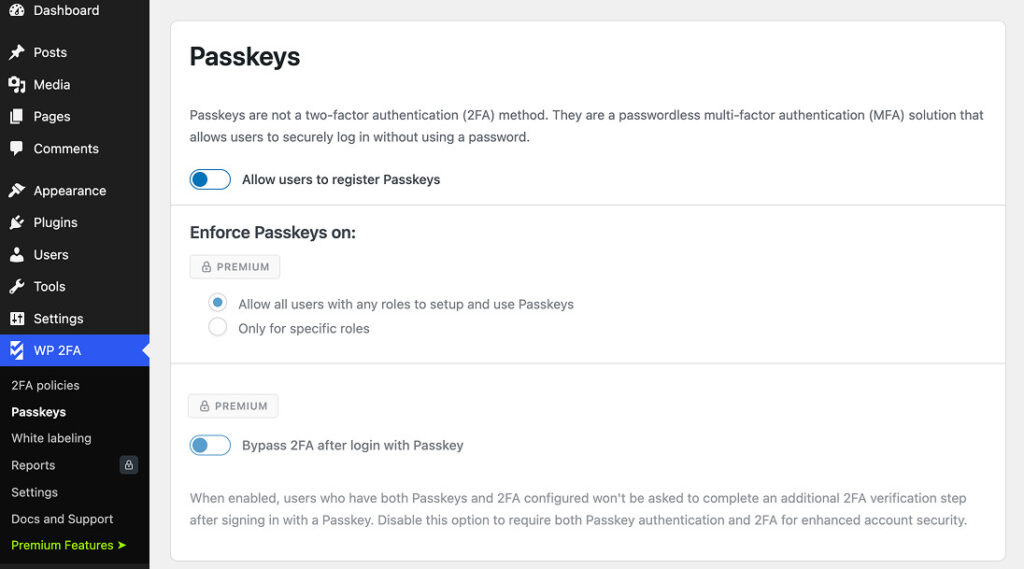
WP 2FA supports the core methods most sites need: authenticator app codes, email codes,ad passkeys and backup codes. Authenticator app support is the most important part because TOTP apps are usually the right balance of security and usability for WordPress admins.
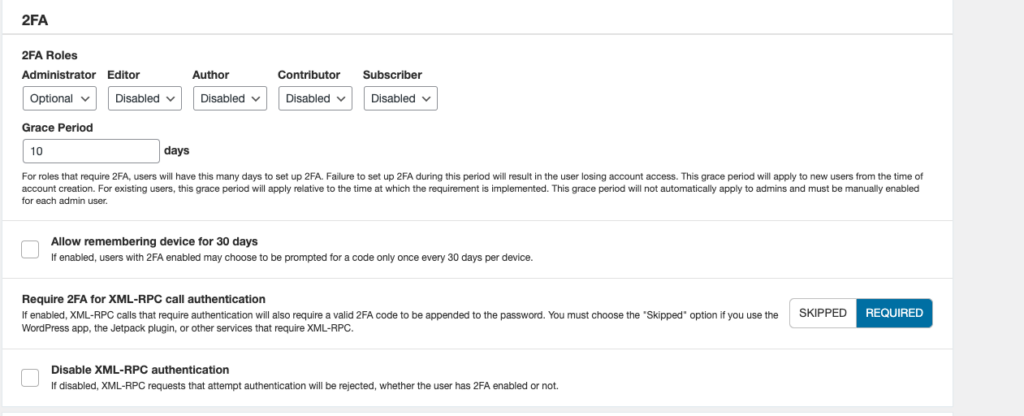
The policy controls are the stronger reason to choose it. You can enforce 2FA by role, give users a grace period, and avoid the common mistake of turning on mandatory 2FA before anyone knows how to recover access or restrict user access in WordPress cleanly.
That matters for teams. A solo blogger can set up 2FA and move on. A WooCommerce store with admins, shop managers, support staff, developers, and content editors needs a rollout plan.
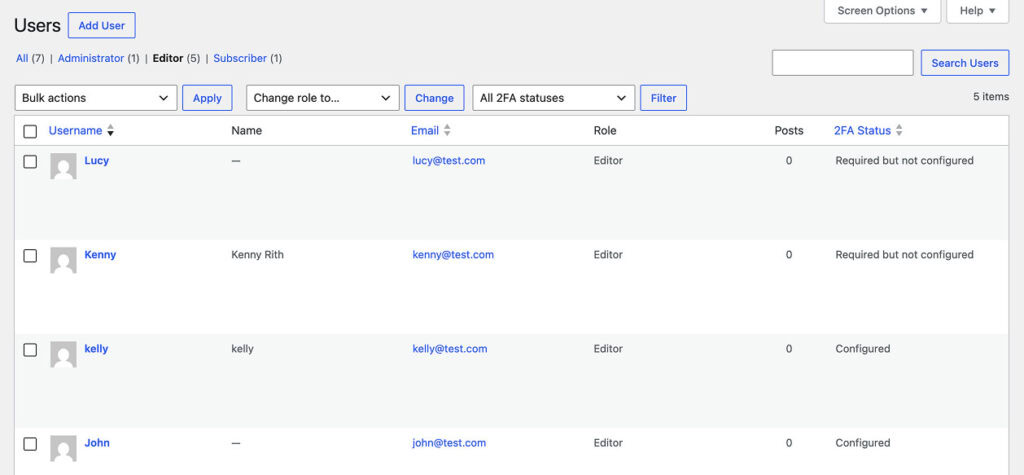
WP 2FA also has practical WordPress-specific surfaces: multisite support, setup forms, setup notices, WooCommerce login detection, and shortcode-based setup options. These details are less exciting than “supports many methods,” but they are closer to what makes a plugin usable.
Watch Out For
Some advanced features and WooCommerce conveniences are paid. That does not make WP 2FA a bad free plugin, but it does mean you should check the exact feature you need before promising a rollout to a client or team.
Email codes are convenient, but they are weaker if the user’s email account is also compromised. For admin accounts, prefer an authenticator app and keep backup codes somewhere secure.
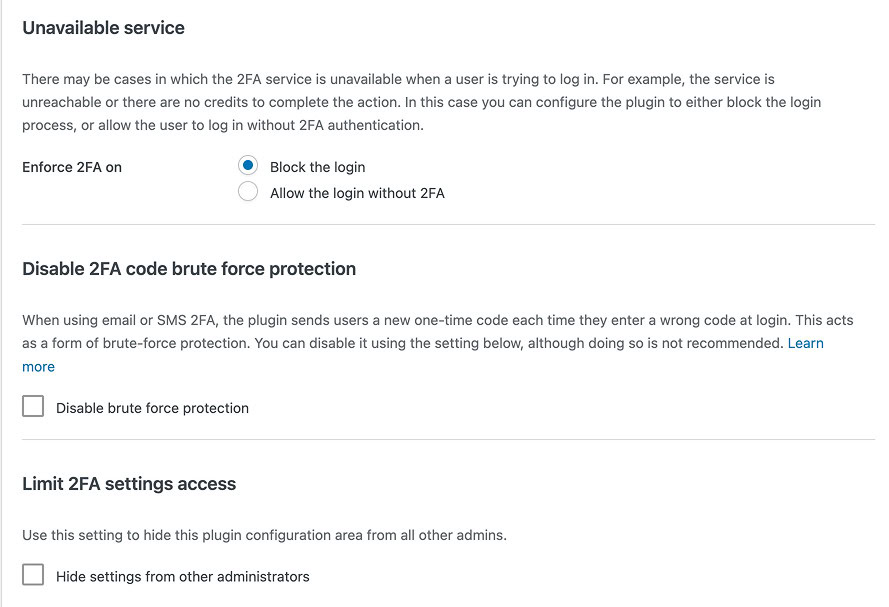
The general settings also show why recovery behavior needs to be reviewed before rollout.
Free Vs Paid Notes
The free version is strong enough for many sites because it supports all-user 2FA and the core policy flow. Paid features are more relevant when you need smoother custom login handling, advanced methods, or more polished team management.
Bottom Line
WP 2FA is the best standalone WordPress 2FA plugin for most sites. It focuses on the part admins actually struggle with: enforcing 2FA safely across real users.
2. miniOrange 2FA: Best For Complex MFA Requirements
miniOrange 2FA is the plugin for admins who read a simple 2FA feature list and immediately think, “That will not cover our login process.”
It supports a much wider set of authentication paths than most WordPress 2FA plugins. That makes it powerful for complex sites, but it also makes it easier to overbuy or overconfigure.
Best for: agencies, enterprise-style WordPress setups, regulated teams, membership platforms, and sites that need many MFA methods or integrations.
Skip it if: you just want free authenticator app 2FA for every WordPress user. The free plan limit changes the value calculation quickly.
What Works Well
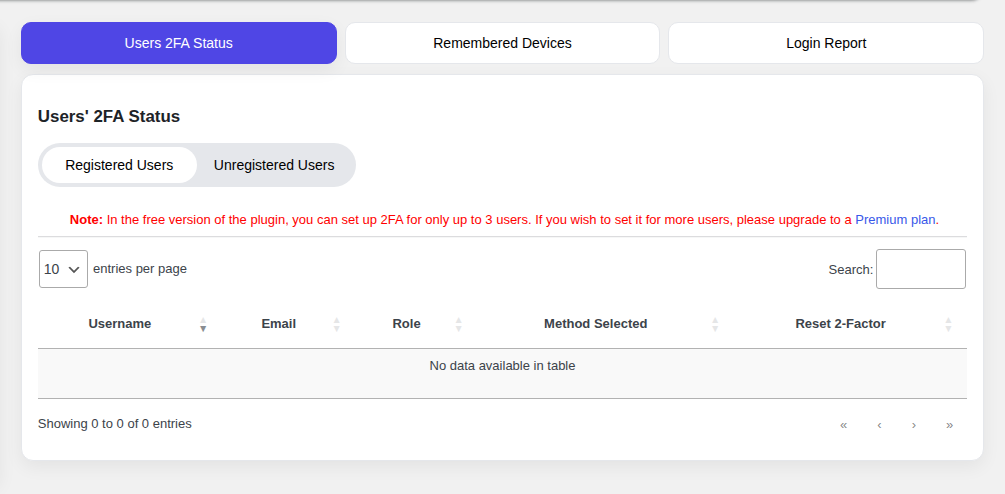
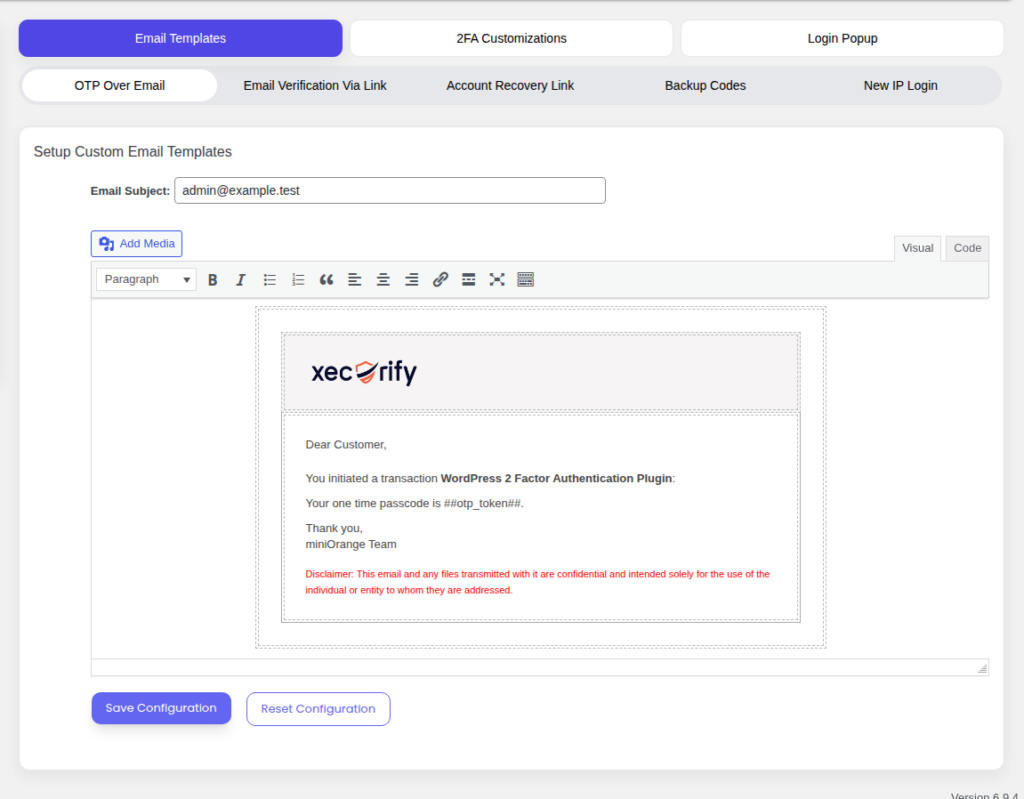
miniOrange supports a broad set of methods and controls: authenticator app codes, email OTP, SMS paths, messaging-app OTP paths, security questions, backup codes, role-based policies, remembered devices, reports, custom redirects, and form integrations.
That breadth is useful when your users are not all the same. A technical admin may be fine with an authenticator app. A customer-facing membership site may need a different path. An agency might need role-specific rules and reports so clients can see who has 2FA enabled.
The plugin also reaches beyond simple 2FA into adjacent login-security controls. That can be helpful if you are trying to standardize authentication across a more complicated WordPress environment.
Watch Out For
The free version is limited to three users. For a single-owner site, that may be fine. For a team, store, publication, or client site, it can become a paid decision almost immediately.
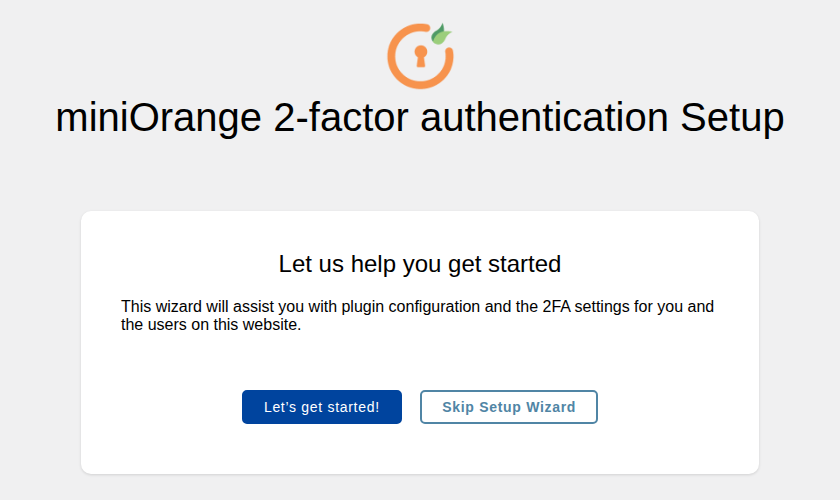
The settings surface is also larger. More methods and integrations mean more choices, more testing, and more room for someone to configure a policy that looks secure but annoys legitimate users.
This is the hidden cost of complex security tools. The extra feature you do not need still has to be understood, ignored, or explained to someone.
Free Vs Paid Notes
Use the free plan only if the three-user limit fits the site. If you need team-wide enforcement, plan for paid usage and review the method limits before rollout.
Bottom Line
miniOrange 2FA is the strongest pick for complex MFA needs. It is not the cleanest default for a small site, but it is the better fit when authentication has to support many user types, methods, and policies.
3. Wordfence Login Security: Best Free Focused Login-Security Option
Wordfence Login Security is a good choice when you want 2FA plus a few login hardening controls without installing a broad security suite.
It is especially appealing if your concern is not only stolen passwords, but also noisy login abuse: bots, CAPTCHA-worthy attempts, and XML-RPC exposure.
Best for: site owners who want free 2FA with extra login controls, especially CAPTCHA and XML-RPC protection.
Skip it if: you need many authentication methods or a policy-heavy 2FA rollout for a larger team.
What Works Well
The plugin brings Wordfence’s login-security pieces into a more focused package. You get 2FA, CAPTCHA, and XML-RPC protection, which is a practical combination for sites seeing repeated failed login attempts or needing to block IP addresses in WordPress.
This is useful because not every login problem is the same. 2FA helps if an attacker has a valid password. CAPTCHA and XML-RPC controls help reduce some automated login abuse before it becomes a daily irritation.
For budget-sensitive sites, that combination makes Wordfence Login Security a credible free option.
Watch Out For
It is less flexible as a pure 2FA tool than WP 2FA or miniOrange. If your buying decision is about graceful team rollout, custom login flows, or many MFA methods, this is not the strongest pick.
The rating volume is also lower than the bigger plugins in this list, so check recent support threads and compatibility before using it on a high-value site.
Free Vs Paid Notes
The focused plugin is attractive because the core login-security value is free. If you already use the full Wordfence ecosystem, compare whether you want the standalone login plugin or the broader security plugin.
Bottom Line
Wordfence Login Security is a strong free option for focused login hardening. Choose it when CAPTCHA and XML-RPC controls matter as much as the 2FA prompt itself.
4. Two Factor: Best Simple Open-Source 2FA Plugin
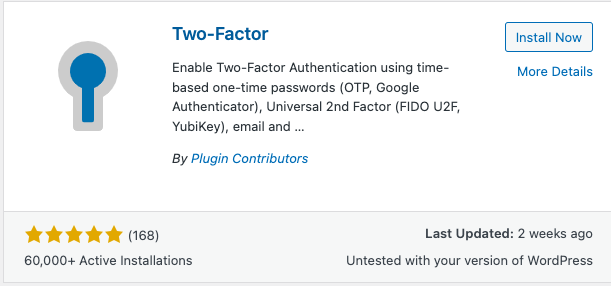
Two Factor is the clean, developer-friendly option for people who want less product machinery around 2FA.
It is free, maintained, and straightforward. That is a real advantage if you do not want a security plugin that turns every setting page into a sales conversation.
Best for: developers, DIY admins, small sites, and teams that prefer a simple profile-level 2FA plugin.
Skip it if: you need strong centralized enforcement, guided rollout, polished reporting, or client-friendly policy management.
What Works Well
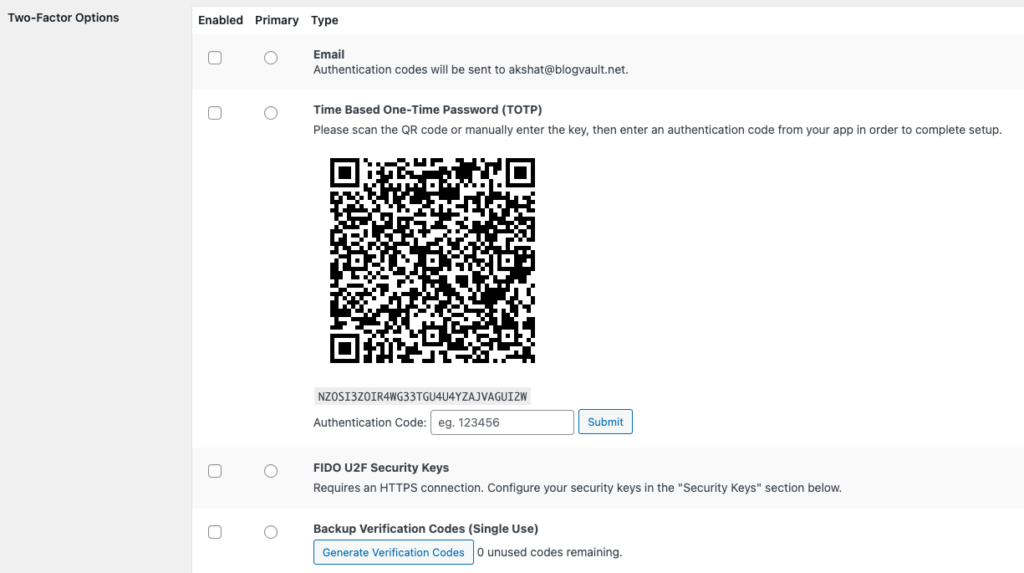
Two Factor focuses on the core job: enabling 2FA for WordPress users. It is a good fit when the admin knows what they are doing and does not need a heavy wizard or commercial policy layer.
The simplicity is also its selling point. A smaller settings surface can be easier to audit, easier to explain, and easier to keep out of the way.
This is the plugin I would consider for a technical owner who says, “I just want a maintained free 2FA plugin, and I do not need a dashboard full of upsells.”
Watch Out For
Profile-level simplicity becomes a weakness when you need organization-level control. Agencies, WooCommerce stores, and multi-author publications often need to know who has enrolled, who is exempt, and when enforcement begins.
That is where a policy-driven plugin like WP 2FA is usually safer.
Free Vs Paid Notes
Two Factor is a strong free option with no premium ladder shaping the recommendation. The tradeoff is not price; it is admin control.
Bottom Line
Two Factor is the best simple open-source pick. Use it when you value clean, free, profile-level 2FA more than centralized rollout management.
5. Two Factor Authentication: Best Lightweight UpdraftPlus-Adjacent Option
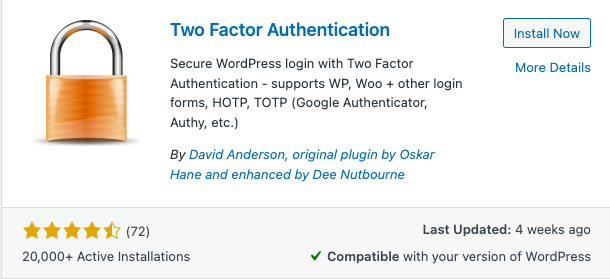
Two Factor Authentication is a lightweight option from the UpdraftPlus team. It is worth considering if you want a simple TOTP/HOTP setup and do not need the strongest free enforcement controls.
It is not the plugin I would choose first for mandatory team-wide rollout, but it has a clear place for smaller sites that want basic authenticator app protection.
Best for: small sites, UpdraftPlus-adjacent users, and admins who want a lightweight TOTP/HOTP plugin.
Skip it if: mandatory enforcement, emergency codes, and trusted-device controls need to be free.
What Works Well
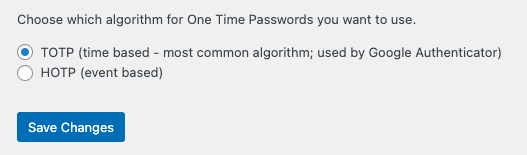
The plugin supports TOTP/HOTP authentication, QR-code setup, shortcodes, WooCommerce/custom form support, and multisite use cases. Those are practical features for a plugin that is trying to stay lighter than the all-in security suites.
The WooCommerce and custom form support matters more than many people expect. If your users log in outside the standard wp-login.php screen, you do not want to discover compatibility problems after turning on enforcement.
Watch Out For
Important rollout features such as enforcement, trusted devices, and emergency codes are premium. That is the major reason this plugin is not the default recommendation.
For optional 2FA on a small site, this may be fine. For required 2FA across a team, recovery and enforcement are not luxuries. They are part of the safety system.
Free Vs Paid Notes
The free version is useful for basic authenticator app setup. Treat the paid version as the more realistic option if you need mandatory 2FA and safer recovery controls.
Bottom Line
Two Factor Authentication is a good lightweight choice, but its free limits matter. Use it when the feature split matches your rollout plan.
6. MalCare: Best When 2FA Is Only One Part Of The Security Problem
MalCare is not the best standalone 2FA plugin, and it should not be judged as if it were trying to be one.
It belongs in this list because many people searching for a WordPress 2FA plugin are really asking a larger question: “How do I stop my site from getting compromised?”
2FA helps with one class of risk: unauthorized logins using stolen, guessed, reused, or phished credentials. It does not detect malware, clean infected files, patch vulnerable plugins, block every attack path, or help you track WordPress user activity well enough to know whether a strange admin user was created last week.
Best for: site owners worried about full-site compromise, agencies managing many sites, WooCommerce stores, and anyone who needs scanning, cleanup, firewalling, vulnerability detection, and login protection together.
Skip it if: all you need is a standalone 2FA prompt for WordPress users.
What Works Well
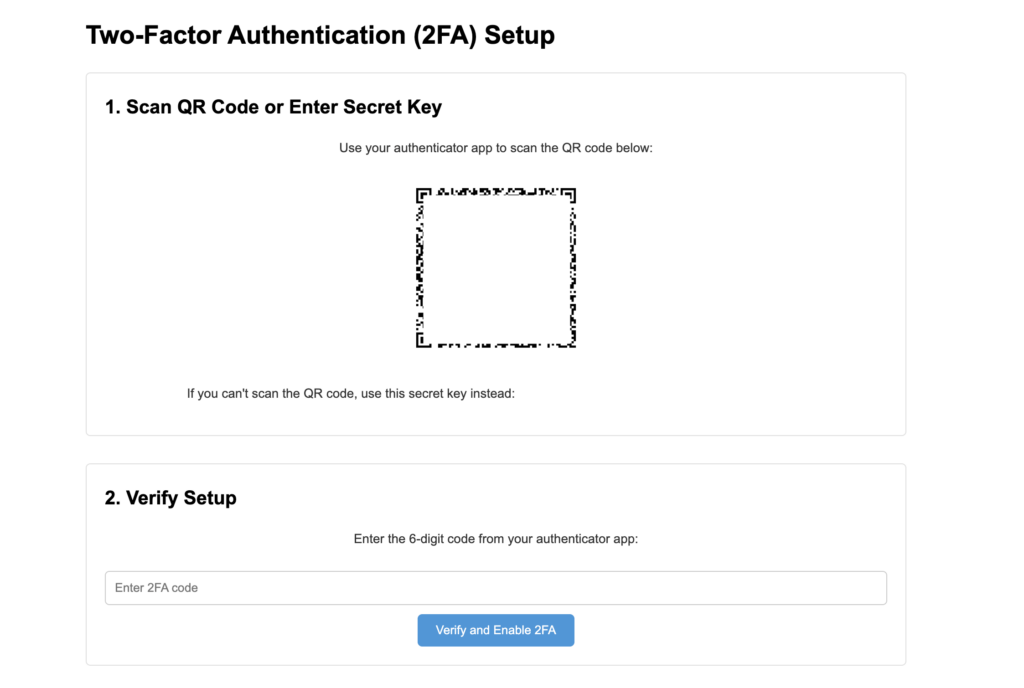
MalCare is the better path when login protection is only one layer in the stack. A complete WordPress security workflow also needs malware scanning, firewall protection, vulnerability monitoring, cleanup, and ongoing visibility.
This matters most when something already feels wrong. If you are seeing unknown admin users, unexpected redirects, spam pages, strange file changes, or warnings from browsers and search engines, adding 2FA is not the first fix. You need to check whether the site is already compromised.
Adding a second lock to the front door does not help much if the attacker is already inside.
Watch Out For
Do not choose MalCare if the requirement is narrowly “install a standalone 2FA plugin and enforce it for editors.” WP 2FA is the cleaner answer for that job.
MalCare makes sense when the decision has moved from login authentication to site security.
Free Vs Paid Notes
Evaluate MalCare based on the broader security workflow: scanner, cleaner, firewall, vulnerability monitoring, and operational visibility. It is a different buying decision from a 2FA-only plugin.
Bottom Line
Use MalCare when 2FA is part of a wider security plan. If you suspect compromise or want full-site protection, a standalone 2FA plugin is not enough.
Other WordPress 2FA Options Worth Knowing
Some popular security plugins include 2FA, but they are not the default standalone picks here.
Really Simple Security is worth considering if you already use it for site hardening, SSL, or broader security settings. It has a large install base and strong ratings, but it is not the cleanest choice if the only job is 2FA rollout.
Shield Security can make sense for users who want a broader security suite with authentication features. It is not the first recommendation for a focused 2FA comparison because the decision becomes about the whole suite, not just login authentication.
Wordfence Security is the better-known full Wordfence plugin. It may be right if you want firewall and malware scanning alongside login security, but it is heavier than the standalone Wordfence Login Security plugin.
Kadence Security, formerly associated with the iThemes/Solid Security lineage, is another broad security-suite option. Check current features and pricing carefully before choosing it only for 2FA.
The pattern is simple: if you want a 2FA plugin, choose a 2FA plugin. If you want a security suite, judge the whole WordPress security plugin.
What To Check Before Enforcing 2FA
Do not turn on mandatory 2FA for everyone and hope the support queue stays quiet.
Before enforcement, check these items:
- Create and store backup codes for every privileged account
- Confirm how an admin can reset 2FA for a locked-out user
- Test setup with a non-critical user account first
- Decide which roles must use 2FA and which roles can wait
- Use a grace period so users can enroll without panic
- Confirm custom login forms and WooCommerce login screens work
- Check whether XML-RPC access is needed or should be restricted
- Document what happens when someone loses a phone
- Make sure at least two trusted admins can recover access
The lost-phone plan is the one people skip because it feels unlikely. Then a real person gets a new phone, forgets to transfer the authenticator app, and suddenly “security improvement” becomes “who can still log in?”
For admin accounts, use an authenticator app where possible. Keep backup codes in a secure place that is not the same inbox used for login. Email codes are better than no WordPress two-factor authentication, but they are not ideal if the email account is also at risk.
Is A WordPress 2FA Plugin Enough?
Sometimes, yes. If your site is clean, maintained, and you mainly want to reduce account takeover risk, a good standalone 2FA plugin is a sensible move.
But 2FA is not a full WordPress security plan.
It will not:
- Remove malware
- Find hidden backdoors
- Patch vulnerable plugins
- Monitor every file change
- Block all exploit attempts
- Fix insecure hosting
- Tell you whether an attacker already created another admin account
This is where many site owners choose the wrong tool for the right fear. They see failed login attempts and install 2FA, which may be correct. But if the site is already showing hacked-site symptoms, 2FA is not cleanup.
Start with the state of the site. If the site is healthy and the goal is safer logins, choose WP 2FA or another focused plugin. If the site may already be compromised, or if you need firewall, malware scanning, cleanup, vulnerability monitoring, and login protection together, use a broader security platform like MalCare.
FAQs
What Is The Best WordPress 2FA Plugin?
WP 2FA is the best WordPress 2FA plugin for most sites. It combines guided setup, free all-user 2FA, role policies, grace periods, backup codes, multisite support, and active maintenance.
What Is The Best Free WordPress 2FA Plugin?
WP 2FA is the best free 2FA plugin for most sites that need all-user rollout. Two Factor is a strong free option if you prefer a simpler, profile-level open-source plugin.
Is WP 2FA Free For All Users?
WP 2FA offers free all-user 2FA, which is one reason it is the default recommendation. Check the current plugin page before publication or rollout because paid boundaries can change.
Is miniOrange 2FA Free?
miniOrange 2FA has a free version, but the public free limit is three users. That makes it useful for very small setups but less attractive for teams unless you are prepared to pay.
Does WordPress 2FA Work With WooCommerce?
Yes, several 2FA plugins support WooCommerce or custom login flows, but compatibility depends on the plugin and feature tier. Test with a non-critical account before enforcing 2FA for customers, shop managers, or staff.
What Happens If I Lose My Phone?
You need a recovery path before that happens. Use backup codes, keep at least two trusted admin accounts, and confirm how your chosen plugin lets an administrator reset 2FA for a locked-out user.
Are Email Codes Good Enough For WordPress 2FA?
Email codes are better than no 2FA, but authenticator app codes are usually stronger for admin accounts. If the email account is compromised, email-based 2FA can fail at the same time as the password.
Should I Use A Standalone 2FA Plugin Or A Security Plugin?
Use a standalone 2FA plugin if your main goal is safer WordPress logins. Use a security plugin or platform if you also need firewalling, malware scanning, cleanup, vulnerability monitoring, and broader site protection.
Final Recommendation
Start with WP 2FA if you want the best standalone WordPress 2FA plugin for most sites.
Choose miniOrange if your login requirements are complex enough to justify a heavier MFA tool. Choose Wordfence Login Security if you want a free focused plugin with CAPTCHA and XML-RPC controls. Choose Two Factor if you want a clean open-source option. Choose Two Factor Authentication if you want lightweight TOTP/HOTP and the paid feature split fits your rollout.
And if your worry is bigger than stolen passwords, do not stop at 2FA. Check the whole site, not just the login screen, and make sure you know how to secure your website from hackers.