Sucuri is widely used WordPress security plugin, but nevertheless has serious issues.
- Scanner often misses malware
- Firewall blocks real users
- Lots and lots of false alerts
- Limited vulnerability scanner
- Legacy UI
WordPress security cannot be taken so lightly. It leads to loss of revenue and branding. So if you are looking for an alternative to Sucuri, you’ve found it.
Use MalCare security for 360-degree WordPress security.
MalCare’s malware scanner finds the most cleverly hidden malware, the firewall prevents only attacks (not users), and the one-click malware removal is a blessing for quick damage control.
We are not making this recommendation lightly. We thoroughly tested all the best Sucuri alternatives, and published the results.
MalCare Security is the best alternative to Sucuri you can find. It is a comprehensive security plugin, right from deep scanning your entire site and advanced firewall for protection, to one-click cleanups for easy malware resolution you can have.
The shift away from Sucuri isn’t just about interface or pricing; it’s about the fundamental change in how sites are attacked. As our original research into AI and WordPress vulnerabilities shows, hackers are now using Large Language Models (LLMs) to weaponise zero-day exploits in minutes rather than days.
Legacy scanners that rely on manual signature updates simply cannot keep pace with automated threats.
Alternatives to Sucuri at a glance
We have reviewed Sucuri extensively as a security plugin for WordPress, and frankly, their approach has struggled to keep pace with the sophisticated malware injections we are seeing of late. While it has a malware scanner, firewall, and manual cleanup service, it doesn’t always do the best job.
Sucuri’s scanning often misses what’s happening inside your WordPress site.
Furthermore, the DNS changes needed for setup can cause unnecessary latency and headaches. If you’ve found Sucuri’s scanner too shallow or their firewall too difficult to configure, here are the modern alternatives:
- MalCare Security: The overall winner for WordPress security.
- Wordfence: The best choice for zero-budget security.
- Cloudflare: Best for DDoS protection, replacing Sucuri as a DNS firewall.
- Patchstack: Best for non-WordPress site security.
That’s why you’re looking for an alternative to Sucuri; because it failed you. Either it left malware on your site, or block a real user from logging in. Maybe it sent a bunch of false positives, or missed some critical vulnerabilities from being exploited by hackers.
What we look for during testing
When we reviewed alternative plugins to Sucuri, we focused on three main factors:
- Malware detection
- Malware removal
- Firewall
These are the most important aspects for your WordPress website’s safety.
We also checked things like brute force protection, vulnerability checks, and two-factor login. But if the 3 main factors aren’t good, the other features don’t matter.
We also tested Sucuri for benchmarking. It did not detect any malware on our hacked WordPress sites, and only detected 2 out of 3 vulnerabilities. The configurations and firewall installation were complicated to set up. On the plus side, the cleanup service was great.
Finally, we checked performance on a standard WooCommerce store hosted on a mid-tier shared server. We measured the impact on PageSpeed metrics, in order to test for latency. Sucuri’s DNS setup adds up to 200ms of latency for users geographically distant from their nodes. MalCare shows near zero impact, which has independently been tested.
Sucuri alternatives ranked
1. MalCare

MalCare security is a top security plugin for WordPress and easily excelled in all areas.
It scans every file and database entry for malware and identifies it quickly. After detecting hidden malware on our site, it took just minutes to remove it with a simple one-click cleanup. You can schedule scans, and get alerts for any suspicious activity.
The malware scanner didn’t slow down our site, which was a problem with other WordPress security plugins. In fact, after installing the plugin, we noticed an improvement in site performance.
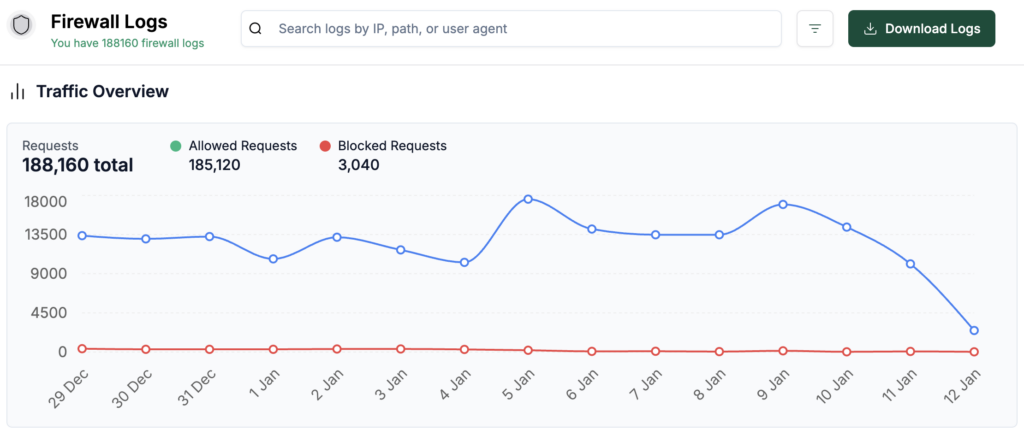
The firewall worked effectively, keeping out harmful bots and requests, as shown in real-time logs.
Although it might sound like we’re boasting, these tests were done by team members who hadn’t used the product before. Their findings were unbiased and highlighted the strong security MalCare offers WordPress sites.
The best part is that, unlike Sucuri or Wordfence, MalCare does not bombard you with false positives and alerts. So if there is an attack, the alert will not get buried under other emails.
Features
- Advanced malware scanner
- One-click auto cleanups
- WordPress-specific firewall
- Activity log
- Login protection
- Vulnerability detection
- Bot protection
- Two-factor authentication
- Geo-blocking IPs
- IP whitelisting
- Uptime monitoring
- Scheduled reports
- WordPress backups
- Staging and migration
- Excellent support
- Unlimited manual malware removal
Pros
- On-demand malware scanning
- Best in class malware detection
- One-click cleanups
- Does not affect server performance
- Real-time alerts
- Automated scans
- No false alarms
Cons
- The free scanner does not show the location of malware
- The free version has a scanner only offers scans and firewall, but no cleaning
Price: Free/ Starting at $149 a year
Summary
Zero performance impact
Unlike traditional plugins that execute scans on your origin server, MalCare offloads all the computing to its proprietary sync-and-scan architecture. The heavy lifting takes place on MalCare’s servers, meaning your server’s processes remain untouched even during deep scanning.
Additionally, MalCare’s Atomic Security, custom-built for WordPress, blocks out malicious traffic and reduces the risk of an attack. Warding off bots like effectively invariably gives the site a performance boost as well.
Signal-based malware detection
The problem with Sucuri was its unreliability. How can you trust a plugin that gives you a clean bill of health, when it is full of malware?
The answer is that you can’t.
MalCare, on the other hand, sent us precise alerts for malware right after scans. Most alternatives rely on simple signature matching, which is looking for known bad code snippets against a database. This will fail, eventually, because malware changes rapidly. Hackers twist and tweak code to defeat signature databases, which is why heuristic scanning is the only way to stay ahead.
MalCare uses heuristic and behavioural signal analysis to identify malware on a site. This way, it identifies threats and zero-day malware that don’t yet exist in signature databases.
Hassle-free malware removal
MalCare’s malware cleanup isn’t just a file deletion or overwrites. It surgically removes malware from the database and core files without breaking sites. This eliminates the clean-reinfect cycle, common with plugins that only address the symptoms and not the root cause.
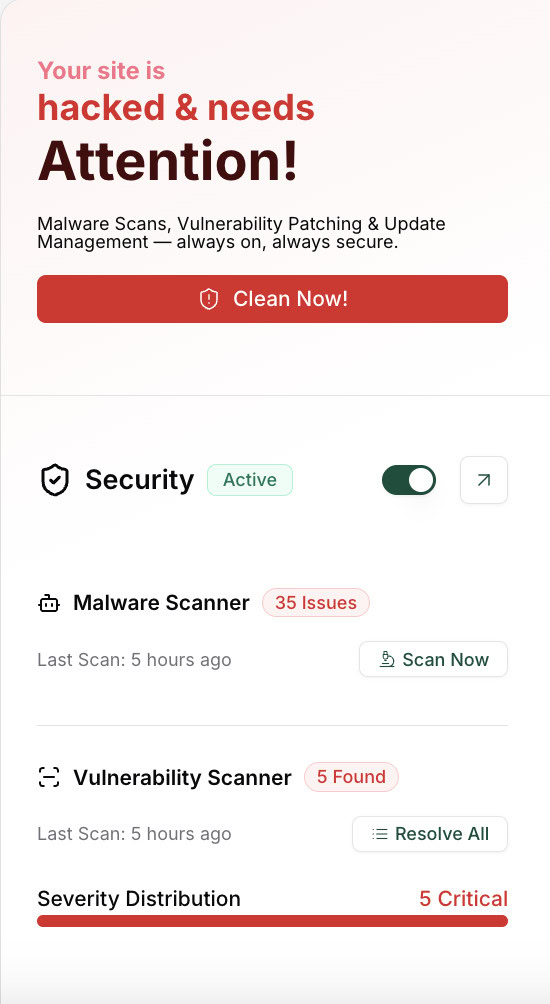
MalCare provides several features that boost WordPress security, including WordPress hardening, backups, staging, and migration.
2. Wordfence

Another big fish in the security pond is Wordfence. Wordfence is quite honestly, the best free security plugin that there is. But if you are looking for complete security, the free version does not cut it.
We expected a lot from Wordfence, considering the brand’s reputation.
And, initially, it impressed us. Installing and setting it up was easy. The first malware scan was slow, but the following ones were quicker.
However, we found that the free version really falls short.
Features
- Malware scanner
- Firewall protection
- Login protection
- Country blocking
- Two-factor authentication
- Reputation checks
Pros
- Easy installation
- Priority support for premium members
- Thorough malware signature database
- Repair option on the free version
Cons
- High impact on server resources
- Signature matching for malware detection
- False positives in malware scans
- 30-day lag on firewall rules
- No activity log
- No bot protection
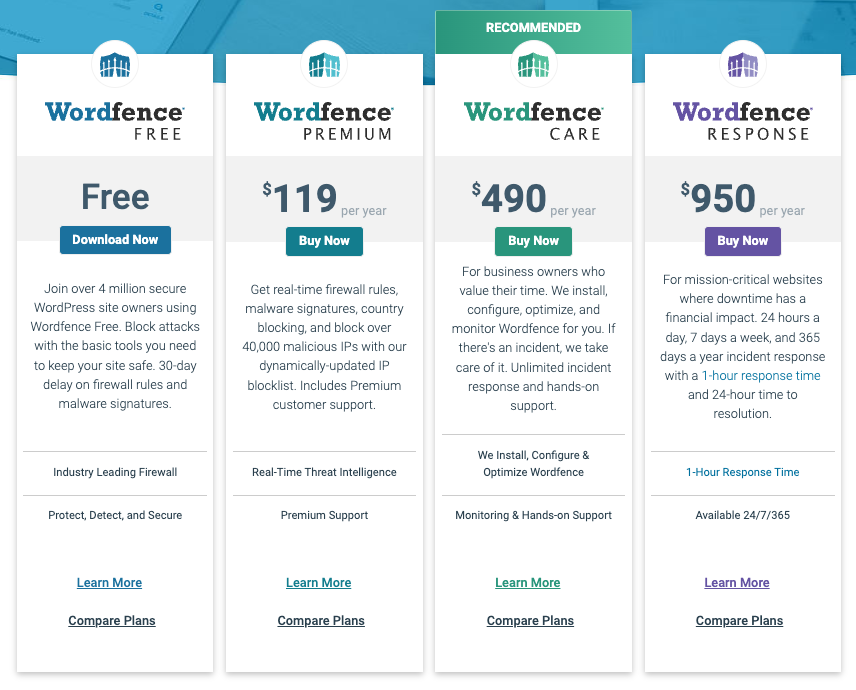
Price: Starts at $99/year; Premium cleanups at $490 per site
Summary
Scanning left us jittery
Wordfence offers a malware scanner that looks for malware by matching malware signatures from their database. Now admittedly, Wordfence’s signature database is quite thorough.
But if it so happens that the particular malware on your site is not in their database, which happens with newer malware, malware in premium themes and plugins, and database malware, Wordfence will not detect it.
And on the flip side, Wordfence is known to show several false positives on its scans.
Free firewall gets updates only after 30 days
Wordfence has a firewall which looks really good to the untrained eye.
(This is where working with a security company comes in handy, because we got the engineering team to explain its shortcomings.)
The firewall loads too late. More specifically, it loads after WordPress, and therefore it only blocks out a part of the malicious traffic, not all.
Since firewalls operate on rules, you would need the latest and best firewall rules to really protect a site. Wordfence free users will get the rules on a 30-day delay. We get that every company needs funds to function, but those 30 days leave free users wide open to exploits.
Hack cleanups can either break your site or break your bank
Wordfence has a repair functionality, which allows you to delete some files and repair others. There is no clear indication of what they are deleting: whether it is custom code or actual malware. As Wordfence doesn’t backup your site before this cleanup, the risk is all on you.
They also have a premium cleanup service, which costs a bomb. We cannot comment on the effectiveness of their premium cleanups given that we have not tried them.
Performance impact
Another glitch in Wordfence is that it has a very high impact on server resources. So much so, that many web hosts ban Wordfence from their servers altogether.
Scanning a 2GB+ media site is where most plugins fail. On our mid-tier Cloudways server, Wordfence’s scan spiked CPU usage to 45%, causing a noticeable lag on the frontend. MalCare, because it syncs and scans off-site, completed the same 2GB scan with 0% increase in server load.
Disable “Low Resource Mode” only on a VPS; on shared hosting, Wordfence can easily trigger a 504 Gateway Timeout during a deep scan.Single Point of Failure: Mention that Jetpack requires a WordPress.com connection. If that connection (XML-RPC) is blocked by your host for security, Jetpack’s entire security suite fails silently.
This is the number one reason people shop for alternatives to Wordfence.
Having said all of this, our overall verdict is positive for Wordfence. If you have no budget and need WordPress security, Wordfence will do the job for you.
3. Patchstack
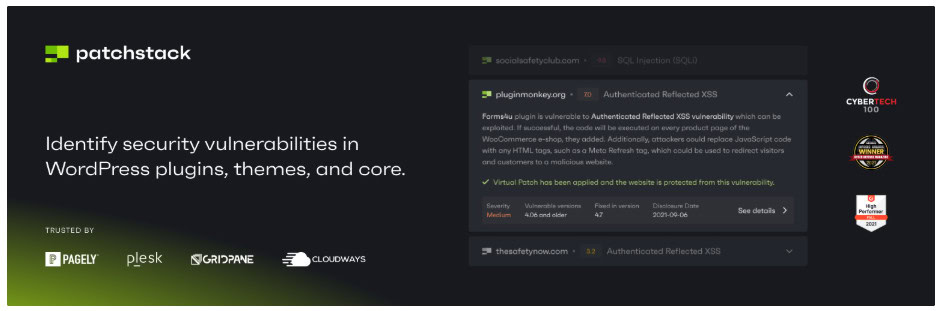
Patchstack is a WordPress firewall that focuses on a single mission: identifying and neutralising plugin vulnerabilities. Unlike general security plugins, Patchstack targets the patching gap, the dangerous window of time between a vulnerability being introduced and it being officially fixed.
Features
- RapidMitigate (formerly vPatches)
- Vulnerability database
- Security hardening
- 2FA
- Captcha for WordPress forms
Pros
- Often provides virtual patches 48 hours before a vulnerability is publicly disclosed
- Options to add security headers, disable directory indexing, and block access to debug files
- Only necessary rules are loaded, keeping the site fast
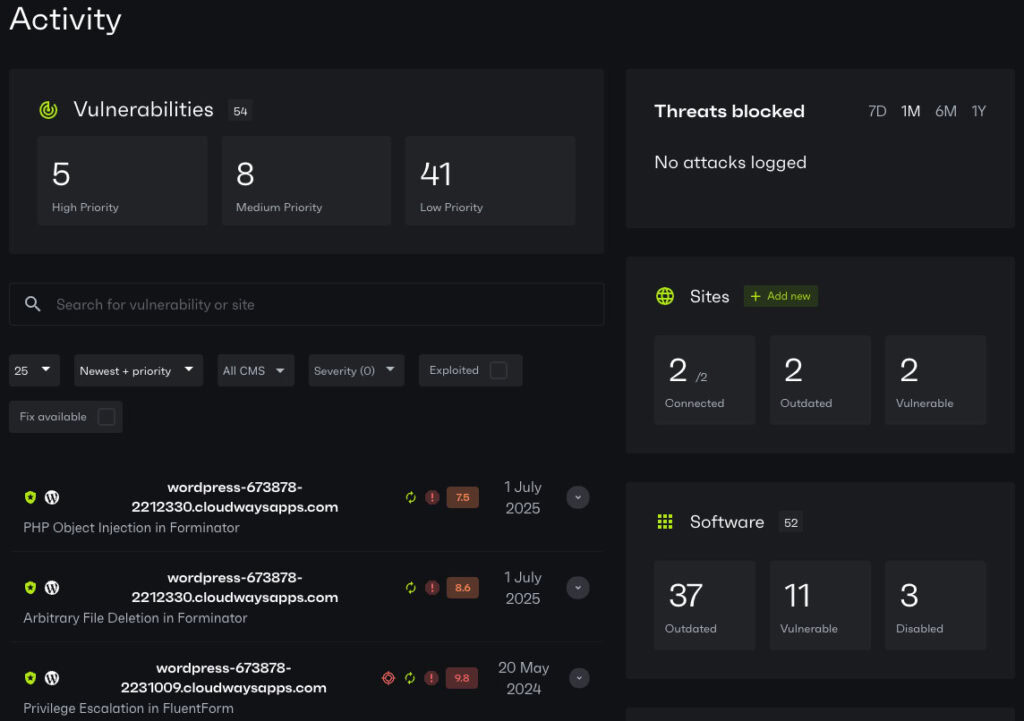
- Actionable dashboard
Cons
- No malware scanner or cleaner
- Incomplete user monitoring (excludes some roles)
Price: Starting at $79/mo for 25 sites
Summary
Heavily dependent on virtual patching
The crux of Patchstack’s value lies in the virtual patching methodology. To use Patchstack effectively, you must understand two key findings from our research on the hidden life of vulnerabilities:
Our data shows vulnerabilities exist for an average of 14 months before discovery. Because Patchstack relies on discovery to issue a virtual patch, your site is unprotected during this time.
While Patchstack buys you time, virtual patching is a partial strategy. It protects you from the moment of discovery until you can apply the developer’s official update. It is not a substitute for a behavioural-based firewall that blocks exploits before they are known to the public.
Extensive vulnerability database
They are usually the first to announce vulnerabilities. If you want to know about a threat before it hits the news, Patchstack is the source.
Malware is, well, your problem
Because Patchstack lacks a scanner, it will leave malware that is already there. It is a shield, not a surgeon. Virtual patching is proactive against known threats but reactive to the discovery cycle. For complete protection, it should be paired with a tool that handles malware detection and removal.
4. Jetpack

You may have heard of Jetpack, given that it comes from the people who created WordPress.
Formerly known as VaultPress, Jetpack is a bundle of a plugin that offers security, backups, and performance. Their plans differ, but you can avail all of these services in a single plugin. We are focusing on Jetpack security for now, as it is most relevant.
Jetpack offers a malware scanner, activity log, login protection, two-factor authentication, and a few more security features.
Features
- Malware scanner
- Brute force protection
- Activity log
- Vulnerability detection
- Two-factor authentication
- Downtime monitoring
Pros
- Good support
- External dashboard
- Integrated with WordPress.com account
Cons
- Inadequate scanning
- Free plan only offers brute force protection
- Inadequate vulnerability detection
- No cleanups
- No firewall
Price: Starting at $150/year
Summary
If you want an honest recommendation, this is not it. Sucuri may have its flaws, but it is definitely a better security plugin than Jetpack.
Doesn’t fully secure a site
Jetpack claims to provide malware scanning, brute force attack protection, and an activity log as part of its security features. When we tested the scanner, it found some hacked files, but not all. It also missed some site vulnerabilities.
The kicker with Jetpack is that it neither offers firewall protection, nor does it provide cleanups. So all it is good for is its UI, which can generate a pretty-looking alert that says you’ve been hacked.
Maintenance features, not security features
Jetpack does have its upsides, it is one of the best-designed plugins that there are. Moreover, Jetpack integrates with a WordPress.com account, acting as an external dashboard for your site.
It does bundle in backups, which are an excellent insurance policy in the case of failed security.
Single point of failure
Jetpack requires a WordPress.com connection. If that connection, which uses XML-RPC, is blocked by your host for security, Jetpack’s security suite fails silently. Features like Stats, Monitor, and Security will stop functioning.
Jetpack may report a Connection Error in the dashboard, but the user doesn’t receive a real-time notification that their protection has dropped. Jetpack’s cloud features require that two-way door to be open. If the door is locked at the server level, the cloud-side protection can’t reach the site to block the attack.
5. All-in-one Security

All-in-One Security often ranks as a popular WordPress security plugin because it’s completely free, with no upsells. It draws in users who are less familiar with WordPress security. It offers a malware scanner, login protection, firewall, and backup of your site’s core files.
But the key question is: does it work? For a security plugin, being free is less important than being effective.
Features
- Security scanner
- Spam security
- Firewall protection
- Brute force protection
- User account security
Pros
- User friendly UI
- Graphs and charts to display data
- IP blocking
- Core files backup
Cons
- Weekly malware scanning
- No cleanups
- Bot protection interferes with indexing
Price: Free
Summary
Consider this plugin if you have no budget, and cannot go with Wordfence.
Inadequate malware scanner
All-in-One used to include a “scanner”, which is actually a file change detection tool that alerts you to changes in your WordPress files. A file change detection scanner only looks for modified files instead of actively looking for malware. Since hackers can alter timestamps or conceal changes, this scanner falls short in providing adequate security.
However, they have introduced a malware scanner recently.
Ineffective firewall
While it offers some firewall protection, it only secures your .htaccess files. This isn’t full protection because if a plugin has a vulnerability, protecting just the .htaccess file won’t help much.
Another major issue with the plugin is that its bot protection is not refined. So the plugin blocks all bot traffic, including good bots such as googlebot—interfering with the indexing process while doing so.
No options to clean hacks
It also offers no cleanups whatsoever.
You can read more in our All in One WP Security and Firewall review, or see how it performs in real-world tests against other security tools like iThemes Security.
6. CleanTalk Security
CleanTalk Security is one of the most affordable security plugins that we have come across. Surprisingly enough, even at prices so low, it offers a range of features such as malware scanning, login security, audit logs, firewall protection, cleanups, and more.
Features
- Malware scanning
- Web application firewall
- Audit logs
- Brute force protection
- IP blocking
- Geoblocking
- Login security
- Two-factor authentication
Pros
- Easy spam removal
- Scheduled auto-scans
Cons
- Difficult to configuration
- Automatically deletes infected files
- Inadequate support
Price: Starting at $9 a year
Summary
But don’t let the price tag and feature list fool you. The malware detection mechanism CleanTalk employs is far from effective. They claim that their scanner would “probably find more than you expect.” The probably and the more than you expect sound more ominous to us than they probably expect.
CleanTalk users also often complain of lack of proper support, which can prove to be a big problem in case you run into issues. We would say that while CleanTalk can be employed for combating spam, it is not a real alternative to Sucuri.
7. Solid Security Pro

Solid Security used to be iThemes security. It has recently been rebranded—and hopefully refactored—into a better security plugin.
In our previous experiece with iThemes, we found it wasn’t an alternative to any functional security plugin, let alone Sucuri. We covered iThemes because over a million sites use it, and rely on it for website security. So we had to set the record straight.
Are things better now? Let’s find out.
Features
- Blocklist scanner
- Login protection
- Brute force protection
- File change detection
- IP blocking
- Database backups
Pros
- Strong two-factor authentication
- Good user management
- Integrates Patchstack in the premium version as a firewall
Cons
- No malware scanning
- No cleanups
- No firewall
- Brute force protection inadequate
- Overall bad security
Price: Free
Summary
As far as Solid Security being an alternative, it doesn’t even qualify to be in the same league as Sucuri.
iThemes got a great facelift
Solid Security Pro is the same plugin as iThemes, just with much better looks. We tried the basic version, which was free. There is a premium version as well, which we didn’t try out.
Scanner is just as bad as before
iThemes claimed to have a site scanner, which is basically just a blocklist scanner that looks up if your site is on the Google blacklist. During site setup, Solid Security scanned the site for vulnerabilities, and found 2 out of the 6 on our site.
Didn’t find any of the malware.

Legacy plugins we tested as well
1. SecuPress

SecuPress entered the WordPress plugin market in 2016 and quickly gained a reputation. It’s known for its user-friendly design and appealing interface. While these features are beneficial, they aren’t the core requirements for a WordPress security plugin.
A deeper look into the plugin tells you about how SecuPress functions.
Features
- Malware scanner
- Scheduled scans
- Firewall protection
- Security Logs
- IP blocking
- Security audit
- Geoblocking
- Backups
Pros
- Aesthetic interface
- Security report generation
Cons
- Inadequate scanning
- No cleanups
- Bad support
- Complicated configurations
- Infrequent updates
Price: Starting at $59 a year
Summary
This is not malware scanning, folks.
The plugin’s malware scanner claims to look for the following:
- Bad files in your FTP.
- Your uploads folder for dangerous files.
- Potential phishing attempts via index.php loads.
The issue with this is that FTP is not a location. FTP is a way to access your website files, much like a file explorer on your personal computer. And looking for malware only in the uploads folder and index.php loads is not even close to being enough.
So it is safe to say that the scanner is not remotely adequate.
Clear issues with the firewall
SecuPress provides a basic firewall and some brute force protection. It seems that because it’s aimed at a French market, users in other regions may find themselves locked out of their sites. From this, we concluded that the firewall could block legitimate users due to issues with geoblocking or global IP protection.
Cleanups, anyone?
SecuPress also does not offer any cleanups, and the support is often a cause of contention with its users.
2. BulletProof Security

BulletProof Security has all the standard features you wish to have in a security plugin. It offers malware scanning, firewall protection, logs, partial backups, and repairs, to name a few features.
However, these features can be challenging for users unfamiliar with them. Installation and setup may involve trial and error for beginners, and the interface suits more advanced users.
Features
- Malware scanning
- Firewall protection
- Security logs
- Database backups
Pros
- Customizable
- One-click setup
- Maintenance mode available
Cons
- No auto-cleanups
- Firewall only protects plugin files
- Repair options allow for file deletion—dangerous
- Plugin not beginner-friendly
Price: $69.95
Summary
Overall, we do not recommend BulletProof security as a Sucuri alternative in any case. But if the licensing and features are convenient for you, the plugin is not all bad. We would still recommend Wordfence over Bulletproof Security when looking for a free security solution.
Confusing malware scanner
Our main issue with BulletProof Security is its overly complex malware scanner. Their documentation states that scanning for malicious code in files isn’t helpful since hackers might install files without harmful code. This is true. However, others like developers, designers, and Google Analytics may also add custom files with non-malicious code. You get the idea.
Malware usually isn’t just sitting in one spot, waiting to be detected. Instead, it’s often spread across various locations, sometimes appearing harmless but harmful as a whole. A good scanner identifies the malicious intent of code and highlights that.
Plus, the scanner has a whole host of configurations, such as it skips large files by default, and does not scan the database unless specified. This can lead to a lot of confusion and scans may skip important parts of the site and miss malware.
Clean at your own risk
Bulletproof also offers a repair option, which essentially allows you to delete infected files. This is a dangerous solution, given that false positives can lead to deletion of important files. This can risk breaking the website, causing extensions to fail, or worsening the situation.
Decent firewall
Their firewall offers basic functions that might block most malicious traffic and attacks.
Additionally, while the firewall is effective, it only protects plugin files, which isn’t sufficient for comprehensive security. On the plus side, BulletProof Security is cost-effective, offering a lifetime license with updates for around $70.
3. Cerber Security

Cerber Security is a relatively unheard of security plugin, but it has several active installations which speak to its efficiency. Cerber is one of the few plugins that offer auto cleanups. For that, it gets brownie points. They offer a malware scanner, firewall protection, auto cleanups, login security, and a few more bells and whistles.
Features
- Malware scanning
- Auto-cleanups
- Firewall protection
- Login security
- IP blocking
- Two-factor authentication
Pros
- Automated scheduled scans
- Easy to use
Cons
- Slows down website
- Automatic deletion of files
Price: Starting at $99 a year
Summary
The zinger, however, is that Cerber’s auto cleanups delete files automatically if it finds any infections. By this time, we have already mentioned several times that not only is this a bad practice, it can actively break your site. Cerber is also known to overload your website server, causing your website performance to take a hit.
Our verdict for Cerber is that it can prove to be an alternative option to Sucuri, but the tradeoff would be lateral.
How to safely remove Sucuri (DNS & plugin)
Just as Sucuri can be a pain to install, it can be a pain to uninstall. We’ve put together a concise list of steps to extricate your site from Sucuri’s clutches, without downtime.
Step 1: Revert the DNS Firewall
Before you change anything, you need to know where your “home” is.
- Log in to your hosting control panel.
- Look for your Server IP or Origin IP . Note it down. This is the address you will point your domain back to.
- Currently, your domain points to a Sucuri IP address. You need to point it back to your hosting IP. Log in to your domain registrar or your DNS provider.
- Locate the DNS management section.
- Find the A Record for your root domain (usually
@orexample.com). - Edit the record, and replace the Sucuri IP with your Origin IP .
- Find the CNAME for
www. Ensure it points either to your root domain or directly to your host’s provided address. - Wait for propagation. DNS changes can take anywhere from a few minutes to 48 hours to propagate globally.
Step 2: Clear the Sucuri cache
To ensure visitors aren’t seeing old, cached versions of your site while the DNS shifts:
- Log in to your Sucuri Dashboard .
- Navigate to Performance > Clear Cache .
- Click Clear Global Cache .
Step 3: Delete the plugin
Once you’ve confirmed your DNS is no longer pointing to Sucuri (you can check this via DNSChecker.org), you can remove the WordPress overhead.
- Log in to your WordPress Admin .
- Go to Plugins > Installed Plugins .
- Deactivate Sucuri Security .
- Click Delete .
Step 4: Clean up the .htaccess file
Sucuri’s hardening features often add code to your .htaccess file that can conflict with new security plugins.
- Use a File Manager or FTP to open your
.htaccessfile in the root directory. - Look for any blocks of code wrapped in
# BEGIN Sucuriand# END Sucuri. - Delete these blocks and save the file.
Our testing framework
To find a true Sucuri alternative, we moved beyond surface-level reviews. We deployed three distinct test environments on a Cloudways (DigitalOcean) mid-tier server to analyse how these security pluginshandle real-world pressure.
The test sites
- Heavy e-commerce store: A WooCommerce site with 1,000+ SKU catalog and high database overhead.
- Media-heavy site with lots of content: A 2GB+ site heavy on images and bloated media folders to test scan efficiency.
- Malware-infected site: A site intentionally pre-infected with malware and known vulnerabilities to check detection accuracy.
Instead of relying on theoretical risks, we ran an active brute force simulation. We launched a high-frequency dictionary attack against the wp-login.php .
Factors to consider when choosing a Sucuri alternative
When looking for the best WordPress security plugins, focus on more than just their claims. Some plugins make big promises but deliver little. Avoid falling for misleading marketing. As you explore Sucuri alternatives, prioritize these key features in your security plugins:
Essential security features
- Malware Scanning
- Malware Cleaning
- Firewall
These features are critical—and therefore non-negotiable.
Without an effective scanner, detecting all malware on your site is nearly impossible, rendering it ineffective. Malware cleaning acts like a med kit—it’s essential for emergencies. A firewall helps prevent most attacks, reducing the chance of malware issues. If a security plugin handles these well, everything else is a bonus.
Nice-to-have security features
- Vulnerability Detection
- Brute Force Login Protection
- Activity Log
- Two-Factor Authentication
These features enhance your website’s overall security if the plugin already covers the basics. They allow you to spot vulnerabilities early, stop brute force attacks, thoroughly diagnose your site, and add login protection. Together, they are valuable additions.
Potential problems
Some WordPress security plugins, like Sucuri, may use up your website’s server resources during scans. This can affect your site’s performance if servers become overloaded. Security shouldn’t compromise performance. Choose a WordPress security plugin that won’t drain your server resources unnecessarily.
Conclusion
Post-2025, the criteria for a Sucuri alternative has shifted fundamentally. We are no longer just fighting script kiddies or static botnets; we are defending against AI-weaponized exploits that can identify and weaponise a plugin vulnerability in seconds.
As our original research on AI and the future of vulnerabilities demonstrates, the outside-in, legacy approach used by Sucuri is no longer enough. If your security tool waits for a manual signature update to block a threat, you are already too late.
- Choose MalCare if you run a business-critical site that cannot afford a single second of downtime or latency. Its behavioural-signal detection is built specifically for ever-changing threats, and its off-site architecture ensures your server stays 100% focused on your customers.
- Choose Wordfence if you are a hobbyist with a technical background who enjoys digging into live traffic logs and doesn’t mind the high CPU overhead on your server.
- Choose Cloudflare if you already have a clean site and simply want edge-caching and DDoS mitigation. It needs to be used alongside a dedicated WP malware scanner .
Don’t settle for legacy security. The best alternative isn’t the one with the most history; it’s the one that is built for the threats of tomorrow. For most WordPress users, MalCare is the only solution that bridges the gap between high-performance hosting and AI-ready defence.
FAQs
Yes, the Sucuri website firewall is safe. However, the configurations are not easy to handle, and may cause a headache. Sucuri’s firewall works like Cloudflare’s as a DNS firewall.
Sucuri offers good protection for your website. But it has gaps, like the scanning is not adequate, it overloads the server, does not detect all vulnerabilities, and only offers manual cleanups. For a more comprehensive security solution, we recommend MalCare.
Yes. Sucuri actually slows sites down in two ways: 1) The DNS handshake (network latency) and 2) The scanning overhead (server resources). Sucuri uses your server resources to run the scans and they cause a spike in processing power usage. This spike can be considerable for e-commerce websites or large sites, and can significantly affect your website performance.
While both security plugins have flaws, Wordfence offers a more rounded solution in terms of WordPress security. The Wordfence scanner and firewall are stronger than Sucuri’s and Wordfence also offers a repair option to its users, which Sucuri does not.